

Low Earth Orbit (LEO) and Geostationary Earth Orbit (GEO) Satellite Market Size, Share, Trends and Forecast to 2030

The Business Research Company
Low Earth Orbit (LEO) And Geostationary Earth Orbit (GEO) Satellite Market Overview
The Business Research Company's Low Earth Orbit (LEO) and Geostationary Earth Orbit (GEO) Satellite Market Size, Share, Trends and Forecast to 2030
LONDON, GREATER LONDON, UNITED KINGDOM, October 21, 2026 /EINPresswire.com/ -- "The market for Low Earth Orbit (LEO) and Geostationary Earth Orbit (GEO) satellites has witnessed significant expansion recently, driven by increasing connectivity needs and technological advancements. This sector is set to experience continued rapid growth as demand for advanced satellite services rises across various applications. Let’s explore the current market size, key growth drivers, leading regions, and emerging trends shaping the future of this satellite industry.
Current Market Size and Projected Growth of the LEO and GEO Satellite Market
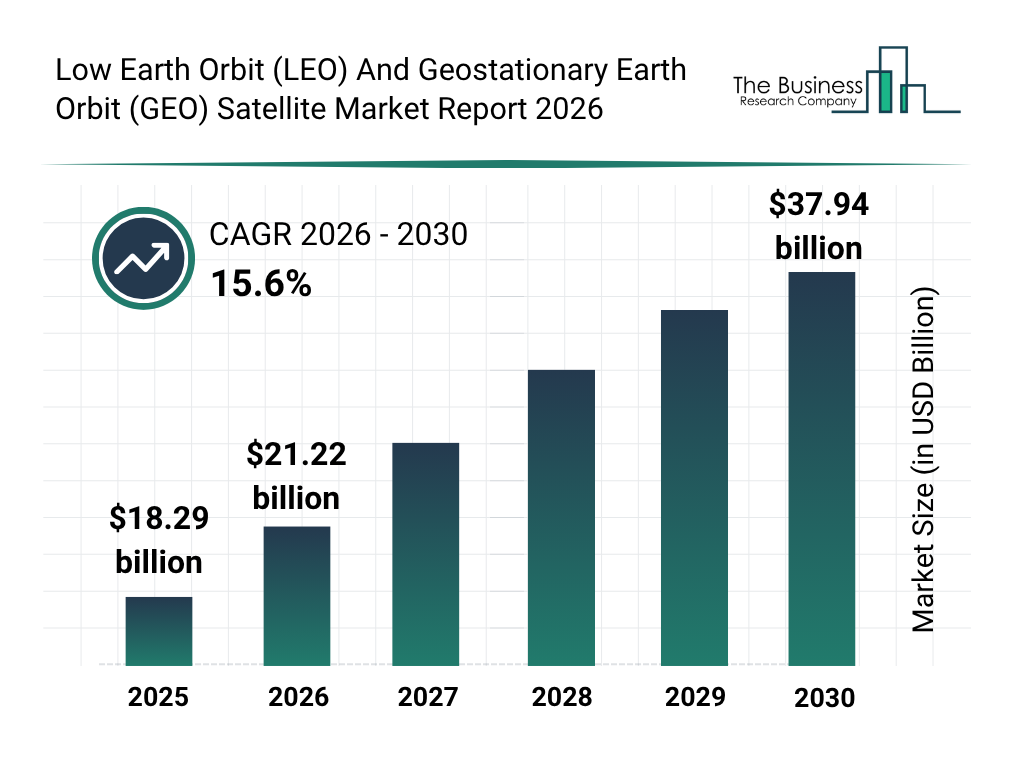
The LEO and GEO satellite market has expanded swiftly in recent years. It is projected to grow from $18.29 billion in 2025 to $21.22 billion in 2026, representing a compound annual growth rate (CAGR) of 16.1%. This past growth reflects increased demand for satellite communications, the widening reach of broadband services, growing needs for earth observation data, and rising satellite navigation requirements, along with the expansion of television broadcasting services.
Download a free sample of the low earth orbit (leo) and geostationary earth orbit (geo) satellite market report:
https://www.thebusinessresearchcompany.com/sample_request?id=49127785&type=smp&name=Low%20Earth%20Orbit%20%28LEO%29%20And%20Geostationary%20Earth%20Orbit%20%28GEO%29%20Satellite%20Market%20Report%202026&utm_source=EINPresswire&utm_medium=Paid&utm_campaign=Oct_PR
Looking ahead, the market is expected to accelerate further, reaching $37.94 billion by 2030 with a CAGR of 15.6%. The forecast period's growth will be driven by factors such as expanding global internet connectivity, wider adoption of direct-to-device communications, heightened demand for real-time earth observation capabilities, increased government investments in satellite infrastructure, and the growth of commercial satellite constellations. Notable trends include more high-throughput satellite deployments, increasing need for low-latency connections, expanding broadband internet constellations, adoption of direct-to-device satellite links, and development of multi-orbit satellite networks.
Understanding LEO and GEO Satellites and Their Applications
LEO and GEO satellites operate in two critical orbital zones around Earth. Low Earth Orbit satellites function at relatively low altitudes and are mainly utilized for broadband internet services, earth observation, remote sensing, and low-latency communications. In contrast, geostationary satellites maintain a fixed position relative to the Earth’s surface and are primarily used for television broadcasting, telecommunications, weather monitoring, and providing consistent regional coverage.
View the full low earth orbit (leo) and geostationary earth orbit (geo) satellite market report:
https://www.thebusinessresearchcompany.com/report/low-earth-orbit-leo-and-geostationary-earth-orbit-geo-satellite-market-report?utm_source=EINPresswire&utm_medium=Paid&utm_campaign=Oct_PR
Key Drivers Fueling Growth in the LEO and GEO Satellite Market
A primary force behind the growth of this market is the rising demand for global broadband connectivity. This connectivity ensures reliable, high-speed internet access across diverse and often remote locations, facilitating communication and data exchange for individuals, businesses, and governments alike. The surge in digital transformation initiatives around the world necessitates uninterrupted, high-capacity internet access, further boosting demand for satellite networks.
Expanding broadband services, especially in underserved and remote areas, are being supported by LEO and GEO satellite deployments. For instance, in November 2025, the International Telecommunication Union reported that 5.5 billion people (68% of the global population) accessed the internet in 2024, up from 5.27 billion users (65%) in 2023. This 4.3% increase, adding approximately 227 million new users, highlights the growing need for global connectivity that satellites help fulfill.
Leading Regions in the LEO and GEO Satellite Market
In 2025, North America held the largest share of the LEO and GEO satellite market. However, the Asia-Pacific region is projected to be the fastest-growing area throughout the forecast period. The market analysis includes key regions such as Asia-Pacific, South East Asia, Western Europe, Eastern Europe, North America, South America, the Middle East, and Africa, providing a comprehensive global perspective on regional growth patterns.
Our 2026 market reports now offer broader strategic coverage through market attractiveness scoring and analysis, total addressable market (TAM) analysis, company scoring matrix graphics and tables, Excel-based forecasting dashboards, market hotspots infographics, key technologies and future trend analysis, along with updated graphics and tables.
Speak With Our Expert:
Saumya Sahay
Americas +1 310-496-7795
Asia +44 7882 955267 & +91 8897263534
Europe +44 7882 955267
Email: marketing@tbrc.info
The Business Research Company - www.thebusinessresearchcompany.com
Follow Us On:
• LinkedIn: https://in.linkedin.com/company/the-business-research-company"
Oliver Guirdham
The Business Research Company
7882 955267
info@tbrc.info
Visit us on social media:
LinkedIn
Facebook
X
Legal Disclaimer:
EIN Presswire provides this news content "as is" without warranty of any kind. We do not accept any responsibility or liability for the accuracy, content, images, videos, licenses, completeness, legality, or reliability of the information contained in this article. If you have any complaints or copyright issues related to this article, kindly contact the author above.
