

Industrial waste could help capture CO₂ and turn it into useful chemicals
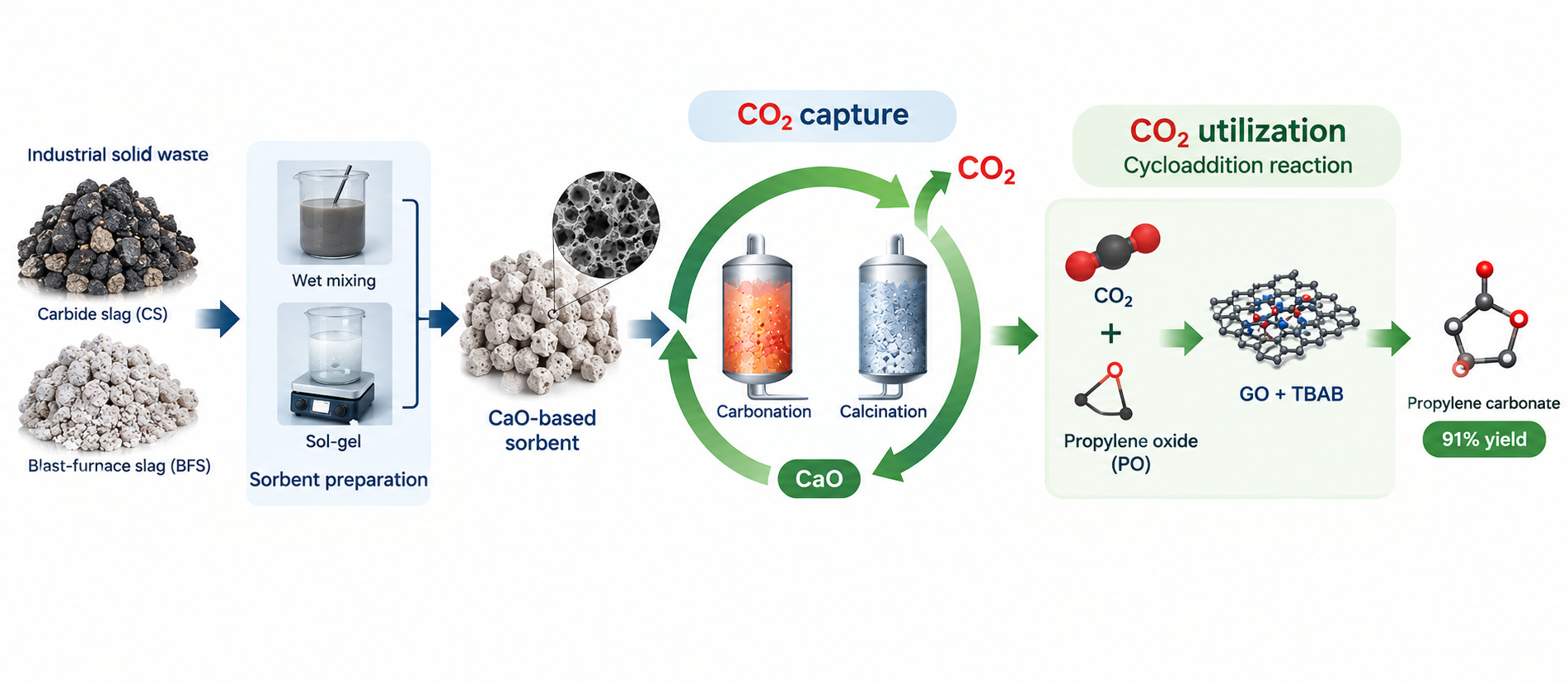
Fig. 1. Schematic of industrial solid waste-derived CaO-based sorbents for high-temperature CO₂ capture and subsequent conversion to propylene carbonate.
Researchers have developed a way to turn industrial waste into materials that capture carbon dioxide and help convert it into a valuable chemical.
The researchers used two industrial by-products, carbide slag and blast furnace slag, to develop materials that can capture CO₂ at high temperatures. Rather than treating these waste materials as something to dispose of, the team explored how they could be given a new purpose.
The team tested different preparation methods and found that a process using sucrose, a type of sugar, helped create a more effective CO₂-capturing material. It also improved the material’s ability to withstand repeated heating and cooling cycles without losing much of its performance.
Under the tested conditions, the material captured 0.552 grams of CO₂ per gram of sorbent at 740°C. Even after 10 capture cycles, it retained 92% of its initial CO₂-capturing capacity.
The researchers then took the process a step further by exploring how the captured CO₂ could be put to use. They reacted to the released CO₂ with propylene oxide, a chemical used in industrial manufacturing, to produce propylene carbonate, a compound with a range of industrial applications.
Using graphene oxide and tetrabutylammonium bromide to support the reaction, the team achieved a propylene carbonate yield of 91%. The approach could also avoid the need to compress and transport CO₂ before converting it into a useful product.
The findings point to a potential way of linking industrial waste recycling with carbon capture and utilisation. By turning industrial by-products into CO₂-capturing materials and then using the captured carbon to make chemicals, the approach could help make better use of existing resources.
Further research will be needed to establish how well the process performs at a larger scale and under real industrial conditions. However, the study offers a promising direction for developing more resource-efficient approaches to managing industrial waste and reducing carbon emissions.
About Green Chemical Engineering:
Green Chemical Engineering is an international, peer-reviewed journal covering sustainable chemistry and chemical engineering. It is indexed in ESCI, EI, Scopus, and CSCD and has an Impact Factor of 11.9 (JCR Q1) and a CiteScore of 18.5.
Read the full article: https://doi.org/10.1016/j.gce.2026.08.002
Andrew Smith
Charlesworth Yansci
+ +44 7478 953600
marketing@charlesworth-group.com
Visit us on social media:
Bluesky
X
Other
Legal Disclaimer:
EIN Presswire provides this news content "as is" without warranty of any kind. We do not accept any responsibility or liability for the accuracy, content, images, videos, licenses, completeness, legality, or reliability of the information contained in this article. If you have any complaints or copyright issues related to this article, kindly contact the author above.
